Search engine optimization (SEO) is not dead — it’s evolving. In 2025, new buzzwords like GEO (Generative Engine Optimization) and AEO (Answer Engine Optimization) are making waves. But what do they actually mean? And how do they differ from traditional SEO? Understanding GEO vs AEO vs SEO is essential for every digital marketer who wants to stay visible in both Google and AI-powered search results.
Table of Contents
The Evolution of SEO
Traditional SEO focused on ranking web pages in Google’s organic results. But the landscape has changed. With AI assistants, voice search, and generative models like ChatGPT, users now expect direct, conversational answers — not just links.
Modern SEO now includes five critical steps: discovery, crawling, rendering, indexing, and ranking. These remain the foundation of digital visibility, but the way we optimize content for them is shifting rapidly.
AEO: Answer Engine Optimization
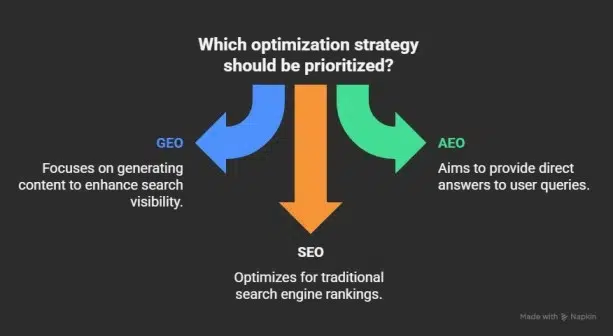
AEO focuses on optimizing content for answer engines — AI systems and voice assistants that deliver instant responses. This means:
- Writing concise, factual, and structured answers.
- Using schema markup and FAQs to help AI understand context.
- Writing concise, factual, and structured answers.
- Focusing on credibility and expertise — Google’s EEAT (Experience, Expertise, Authoritativeness, and Trustworthiness) framework is more important than ever.
GEO: Generative Engine Optimization
GEO is the next frontier. It’s about optimizing content for AI-generated responses in chatbots and generative search systems. GEO requires:
- Entity-based optimization (clear definitions, relationships, and context).
- Structured data to make your brand’s knowledge machine-readable.
- Conversational tone that sounds natural in AI outputs.
In short, GEO ensures your content is part of the conversation — not left behind in static search results.
SEO Still Matters
Despite all the new terms, traditional SEO remains the backbone. You still need strong technical SEO, fast site speed, mobile responsiveness, clean site architecture, and quality backlinks. The fundamentals power everything — even GEO and AEO rely on well-optimized content foundations.
Read more on: Best Professional SEO Services in Indirapuram – SEO Services Ghaziabad in 2025
The Role of EEAT in the New Search Era
EEAT is no longer optional — it’s your credibility signal to both users and AI. Showcase:
- Experience through real insights, case studies, or data.
- Expertise via in-depth analysis or author credentials.
- Authoritativeness by earning mentions and backlinks from trusted sources.
- Trustworthiness through transparent brand communication and updated information.
Why GEO vs AEO vs SEO Matters
Understanding the balance between these three ensures that your brand appears everywhere — on Google, in AI chat responses, and within voice search results. The future of search is not about choosing one; it’s about integrating all three strategically.
Read More on: What is Book Marking Submission in SEO?
Read More on: What is Directory Submission in SEO?
Read More on: What is Book Marking Submission in SEO?
Read More on: What is Profile Creation in SEO?
FAQs About GEO, AEO, and SEO
Q1. What is the main difference between GEO, AEO, and SEO?
SEO focuses on ranking web pages in traditional search engines. AEO optimizes for AI-driven answer systems, while GEO ensures your content is recognized and used in AI-generated responses.
Q2. Is traditional SEO still relevant in 2025?
Absolutely. GEO and AEO are built on SEO fundamentals. Without strong technical SEO, structured data, and high-quality content, AI systems can’t properly interpret your information.
Q3. How can brands prepare for GEO and AEO?
Start by improving your structured data, publishing expert-authored content, and ensuring your site demonstrates EEAT. This builds the trust AI models need to include your brand in their responses.
Q4. What skills will future SEOs need?
SEOs must learn how AI search works, understand entities and schemas, and focus on content that’s conversational, credible, and optimized for both humans and machines.
For Digital Marketing Strategies for Startups Contact us: